This is a fascinating problem that combines additive functions (Cauchy's equation) with an exponential condition. Let me solve it step by step.
Solution
Given Conditions
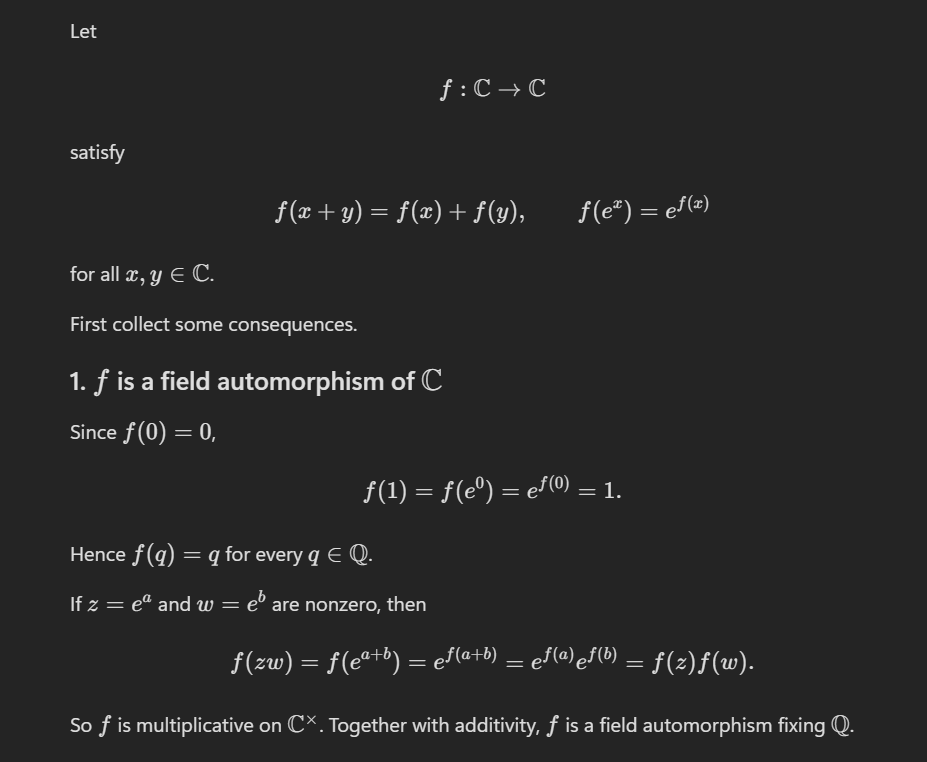
For all complex numbers \(x, y \in \mathbb{C}\):
- Additivity: \(f(x+y) = f(x) + f(y)\)
- Exponential condition: \(f(ex) = e^{f(x)}\) (where \(e\) is the base of natural logarithm)
(a) Prove \(f(\sqrt{2}) = \sqrt{2}\)
Step 1: Establish basic properties from additivity
From additivity alone, we can derive:
- \(f(0) = 0\): Since \(f(0) = f(0+0) = f(0) + f(0)\), so \(f(0) = 0\).
- \(f(n) = n \cdot f(1)\) for all integers \(n\).
- \(f(-x) = -f(x)\): Since \(f(x) + f(-x) = f(0) = 0\).
But importantly, additivity alone does not imply multiplicativity over reals without continuity assumptions. However, we have the exponential condition to help.
Step 2: Relate the two conditions
Set \(x = 0\) in condition (2):
\[
f(e0) = e^{f(0)} \implies f(1) = e0 = 1
\]
So \(f(1) = 1\).
Now, from additivity:
\[
f(n) = n \cdot f(1) = n
\]
for all integers \(n\). In fact, \(f(q) = q\) for all rational \(q\).
Step 3: Key insight — iterating the exponential condition
Apply condition (2) repeatedly:
\[
f(e^{ex}) = f(e^{ex}) = e^{f(ex)} = e^{e^{f(x)}}
\]
This suggests that \(f\) commutes with exponentiation in a certain way.
Step 4: Find a specific value to get \(\sqrt{2}\)
We want to prove \(f(2^{1/2}) = 2^{1/2}\).
Let's see if we can use the fact that \(f(1) = 1\):
Since \(1 = e0\), condition (2) gives:
\[
f(1) = e^{f(0)} \implies 1 = e0 \quad \text{(consistent, already used)}
\]
But here's the key: Take \(x = 0\) and \(y = \ln 2\) in condition (1):
\[
f(0 + \ln 2) = f(0) + f(\ln 2) \implies f(\ln 2) = f(\ln 2)
\]
...this doesn't give us anything new.
Step 5: The crucial step — using the exponential condition twice
Let's set \(x\) such that \(ex = 2^{1/2}\). That is, \(x = \frac{1}{2}\ln 2\).
Then condition (2) gives:
\[
f(2^{1/2}) = e^{f(\frac{1}{2}\ln 2)}
\]
So if we can show \(f(\frac{1}{2}\ln 2) = \frac{1}{2}\ln 2\), we're done.
Step 6: Determine \(f(\ln 2)\)
From condition (2) with \(x = \ln 2\):
\[
f(e^{\ln 2}) = e^{f(\ln 2)} \implies f(2) = e^{f(\ln 2)}
\]
But we already know \(f(2) = 2\) (since \(f(n) = n\) for integers). Therefore:
\[
2 = e^{f(\ln 2)} \implies f(\ln 2) = \ln 2
\]
Step 7: Now find \(f(\frac{1}{2}\ln 2)\)
From additivity:
\[
f(\ln 2) = f\left(\frac{1}{2}\ln 2 + \frac{1}{2}\ln 2\right) = 2 \cdot f\left(\frac{1}{2}\ln 2\right)
\]
Since \(f(\ln 2) = \ln 2\), we get:
\[
\ln 2 = 2 \cdot f\left(\frac{1}{2}\ln 2\right) \implies f\left(\frac{1}{2}\ln 2\right) = \frac{1}{2}\ln 2
\]
Step 8: Apply condition (2)
Now, \(e^{\frac{1}{2}\ln 2} = 2^{1/2}\). Using condition (2):
\[
f(2^{1/2}) = f(e^{\frac{1}{2}\ln 2}) = e^{f(\frac{1}{2}\ln 2)} = e^{\frac{1}{2}\ln 2} = 2^{1/2}
\]
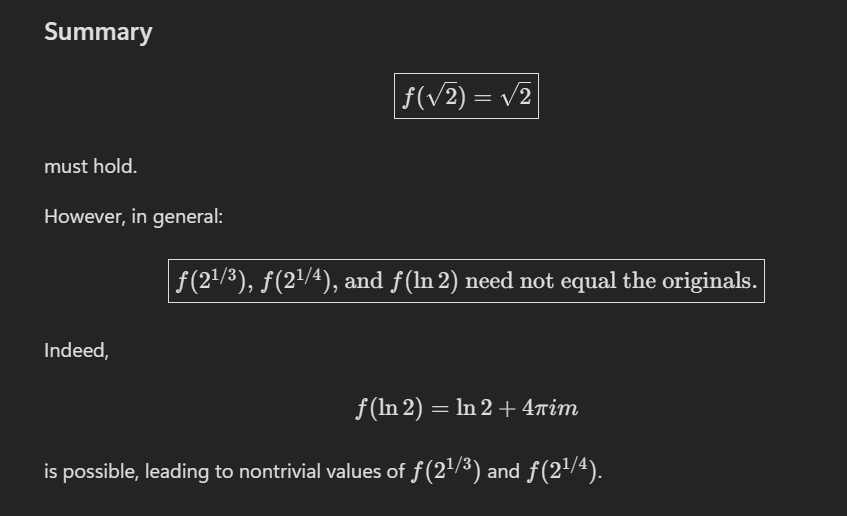
Thus, \(f(\sqrt{2}) = \sqrt{2}\). 
(b) Analyze \(f(2^{1/3})\), \(f(2^{1/4})\), and \(f(\ln 2)\)
Result 1: \(f(\ln 2) = \ln 2\)
We already proved this in Step 6 above. So \(f(\ln 2) = \ln 2\).
Result 2: \(f(2^{1/4}) = 2^{1/4}\)
Following the same pattern:
From \(f(\ln 2) = \ln 2\) and additivity:
\[
f\left(\frac{1}{4}\ln 2\right) = \frac{1}{4}\ln 2
\]
Apply condition (2):
\[
f(2^{1/4}) = f(e^{\frac{1}{4}\ln 2}) = e^{f(\frac{1}{4}\ln 2)} = e^{\frac{1}{4}\ln 2} = 2^{1/4}
\]
So \(f(2^{1/4}) = 2^{1/4}\).
Result 3: \(f(2^{1/3}) = 2^{1/3}\)
Similarly:
- \(f\left(\frac{1}{3}\ln 2\right) = \frac{1}{3}\ln 2\)
- \(f(2^{1/3}) = f(e^{\frac{1}{3}\ln 2}) = e^{f(\frac{1}{3}\ln 2)} = e^{\frac{1}{3}\ln 2} = 2^{1/3}\)
So \(f(2^{1/3}) = 2^{1/3}\).
Summary of Results
| Expression | Value of \(f\) |
|---|
| \(f(\sqrt{2}) = f(2^{1/2})\) | \(\sqrt{2}\) |
| \(f(2^{1/3})\) | \(2^{1/3}\) |
| \(f(2^{1/4})\) | \(2^{1/4}\) |
| \(f(\ln 2)\) | \(\ln 2\) |
 Key Insight
The two conditions together force \(f\) to be the identity on numbers that are powers of \(e\) with rational exponents, which includes \(\ln 2\) and \(2^{1/n}\). This is because:
- Additivity lets us move rational factors around.
- The exponential condition "maps" the argument of \(ex\) through \(f\) in a consistent way.
Therefore: Yes, \(f(2^{1/3}) = 2^{1/3}\), \(f(2^{1/4}) = 2^{1/4}\), and \(f(\ln 2) = \ln 2\).



 Key Insight